

Page views count how many times a page loaded, not what happened after. That distinction is the whole problem with how most technical content gets measured today, and two structural shifts have made it impossible to ignore.
The first is the buyer side. A typical B2B purchase now involves a committee, and each member reads different material at a different point in a long, uneven process. A single page view from a single visitor tells you almost nothing about who on that committee actually mattered, or when. The second shift is on the search side. AI-generated answers now intercept a lot of questions before anyone reaches a website at all, so the click itself has become a minority event rather than the default outcome of a search.
Adding the dark funnel on top makes the picture worse. Peer validation, internal Slack shares, and vendor shortlisting conversations don't show up in an analytics dashboard, but a lot of B2B buying decisions get made there. If a team measures only the touchpoints its tools can see, it will systematically undercount content's actual influence on pipeline.
Attribution complaints top the list of measurement frustrations B2B marketers raise, appearing in survey after survey. The gap between what a dashboard can count and what actually pushed a deal forward is where content teams lose budget arguments, year after year. A lightly-trafficked page might be doing serious work behind the scenes, quietly passed around in private channels, while a page pulling strong traffic numbers contributes nothing to revenue. Most reporting setups can't tell you which is which. Fixing that requires building a different stack of signals, layer by layer, which is what the rest of this piece walks through.
Engagement depth as the first signal between a view and a decision
Before anyone can connect content to revenue, there has to be proof that someone actually read the thing. That's what engagement depth measures, and it's the first rung above a raw page view.
Scroll depth is the simplest version: what portion of readers actually got to the section containing the real argument, rather than bailing after the intro. Time on page matters too, but only when it's adjusted for length. A two-minute read on a short page signals something different than a two-minute read on a lengthy technical guide. Specific actions like whether the reader clicked the demo link, downloaded the spec sheet referenced in paragraph six, or actually played the embedded walkthrough video reveal far more than either scroll depth or time on page. GA4's event model makes a lot of that tracking straightforward, though the more specific actions, like a demo click or a CTA interaction, usually need Google Tag Manager configured on top. Return visits round out the picture. A reader who bookmarks a page and comes back a week later is behaving like someone doing real research, not someone who stumbled in from a random search.
Numbers only tell part of the story, though. Heatmapping tools like Hotjar (and the handful of tools that do similar work) show where readers actually stop scrolling, which paragraphs get re-read, and where they hesitate right before a call-to-action. That's the kind of friction no spreadsheet will ever surface on its own.
None of these metrics mean anything without a target attached first. Every piece of technical content needs a stated job before anyone starts measuring it, whether that's generating leads, pushing a trial signup, or arming a sales rep with a page they can send mid-deal. The right KPI depends entirely on that job. Skipping that step leaves teams chasing metrics that were never tied to a real objective in the first place, which is a bit like grading a fish on its ability to climb a tree.
Engagement depth answers one question well: was this content actually consumed. It cannot answer the next question, which is whether that consumption did anything for the business, and answering that requires a different layer of tracking.
Connecting content consumption to pipeline: the metrics that survive dark funnel blindness
Engagement data only becomes evidence once it's tied to a CRM record. Without that link, a content team can show that a page was read closely and often, and still have nothing to say when someone in finance asks what it did for revenue.
Four connections make that case. First, knowing which specific content assets a lead touched before converting, which takes real UTM discipline and CRM tagging, not just a GA4 goal completion. Second, comparing sales cycle length for leads who engaged with content against leads who never touched any of it. That single comparison tends to be the most persuasive slide in any budget conversation, because it speaks directly to velocity, which sales leadership already cares about.
Third, weighing the cost of producing content against the pipeline it can be tied to. Zapier ran exactly this calculation and landed on a 454% return once every production cost was counted against a three-year customer lifetime value multiplier. It's a demonstration of the math working when a team actually does it. Fourth, track what share of organic traffic lands on pages that sit somewhere on the actual conversion path, separating pages that just answer a curious question from pages that sit in front of a buying decision.
None of the first three connections function without GA4 wired into a CRM like Salesforce or HubSpot. That integration is what lets a team trace a reader from their first anonymous visit all the way to a closed deal. Skipping it stops attribution dead at the form fill, which is a bit like tracking a road trip only as far as the driveway.
Track SQLs instead of MQLs as a scorekeeping fix, since MQLs get inflated easily by anyone who downloads a whitepaper and never enters a real sales conversation. SQLs require actual qualification by a sales rep, which makes them much harder to fake with dark-funnel traffic that never gets logged anywhere.
Software will never see everything, so ask people directly. A single question dropped into an onboarding flow or a post-demo survey, "Which piece of our content was most useful during your research," reveals the private sharing that no tracking pixel will ever catch. If one modestly-trafficked page keeps coming up in those answers, it's getting passed around in Slack channels and inboxes no dashboard can reach, and it's doing real work while it's there.
Even a perfectly wired CRM integration has a blind spot. That's a different measurement problem, and it starts with rethinking what search visibility even means now.
Why search visibility is now a system of signals, not a single rank
A keyword rank is a snapshot, one number, one moment, one query. What actually matters is whether content shows up consistently across the many different ways a buyer searches over the course of a long research process.
Google Search Console gives two numbers that, read together, tell a much richer story than either alone. Impressions show whether a page showed up. Click-through rate shows whether people chose it once it did. The space between those two numbers is exactly where the useful optimization decisions live, since a page with strong impressions and weak CTR has a completely different problem than a page nobody sees in the first place.
Intent type matters just as much as the raw numbers. Navigational, informational, and commercial-investigation queries carry different normal CTR ranges and different pipeline value, so folding them all into one blended ranking number hides which queries are actually worth fighting for. A page ranking well for a broad informational query but never showing up for the commercial-investigation searches right before a purchase decision is winning a battle that doesn't move revenue.
Two problems get treated as one. A page that ranks well but converts nobody has an engagement problem, not a search problem. The rank is doing its job; the page itself isn't holding up its end.
Most published pages, across most sites, earn no meaningful search traffic. That reframes the real question." It's "which pages are actually in the running, and why is everything else sitting untouched."
Quality has also become a much more literal ranking input. Google's March 2026 core update leaned harder into information gain, and pages that just repackage what's already been published elsewhere, without adding original analysis, now face steady downward pressure. Editorial quality used to be a nice-to-have. Now it's load-bearing for rankings themselves.
Google gave content teams a first-party look at the next layer entirely in June 2026, rolling out dedicated generative AI performance reporting inside Search Console, sitting right alongside the traditional ranking data teams already track. That's the exact point where classic search measurement and AI citation measurement become one connected system instead of two separate conversations.
AI citation as a first-class measurement outcome
AI-generated answers are increasingly the last stop before a buyer makes up their mind, making appearing inside those answers a performance number to track rather than a nice-to-have branding goal.
The scale of that shift is hard to overstate. AI Overviews now show up on a large share of sampled U.S. desktop Google searches, making a zero-click result the normal outcome for informational queries, which happens to be the exact category most technical B2B content lives in. G2's 2026 report found that most software buyers now start their research inside an AI chatbot more often than inside Google itself, turning AI citation into a pipeline-stage concern rather than a pure visibility concern.
There's a concrete way to measure this, and it works a lot like traditional share of voice. Share of Model Voice tracks what portion of AI-generated answers, across a defined set of target queries, actually mention the brand. Picture a brand that shows up in roughly a quarter of the AI answers generated for its core buyer questions. A brand appearing in roughly a quarter of answers for its target queries has a measurable, improvable number to work with, the same way a share-of-voice number moves with deliberate effort.
Citation frequency by query type sharpens the picture further. Some question categories produce citations reliably, while others come back empty, and that gap reveals a content hole no keyword ranking tool would surface.
Getting cited isn't automatically a win. If the AI is describing the product wrong, or crediting a competitor's claim to the wrong brand, that citation is actively working against the business. Tools like HubSpot's AEO tracking now follow brand performance across ChatGPT, Perplexity, and Gemini, covering citation frequency, share of voice, sentiment, and competitor visibility all at once. Letterbrace runs on the same logic across every site it manages, treating AI-answer visibility as an equal partner to search visibility rather than an afterthought, tracking not just clicks and impressions but whether the models actually read, cite, and name the client by name when a real buyer asks a real question.
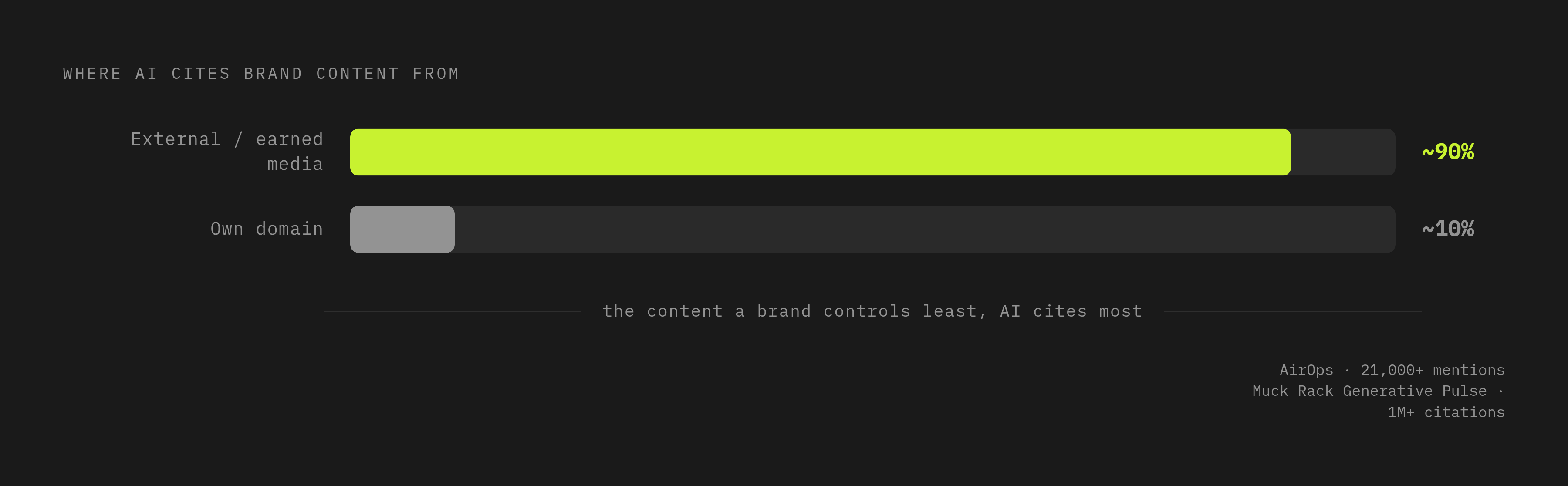
Where those citations come from turns out to matter enormously, and the finding runs against most people's assumptions. AirOps analyzed more than 21,000 brand mentions across ChatGPT, Claude, and Perplexity and found that the large majority came from external sources, with a brand's own website accounting for only a small slice of its total AI citations. Muck Rack's "What Is AI Reading?" report, put out by its Generative Pulse team and built on more than a million citations, backs this up from a different angle: most links cited by AI models trace back to earned media, with journalism making up a substantial share of the total. Put those two findings side by side: the blog post a brand publishes on its own domain earns less weight, and the coverage a brand earns from outside sources is what AI models are actually reading and repeating.
What content properties make a page eligible for AI citation
The properties that make a page more likely to get cited by an AI model are the same qualities that have always marked genuinely authoritative technical writing. They're the same qualities that have always separated genuinely authoritative technical writing from filler content.
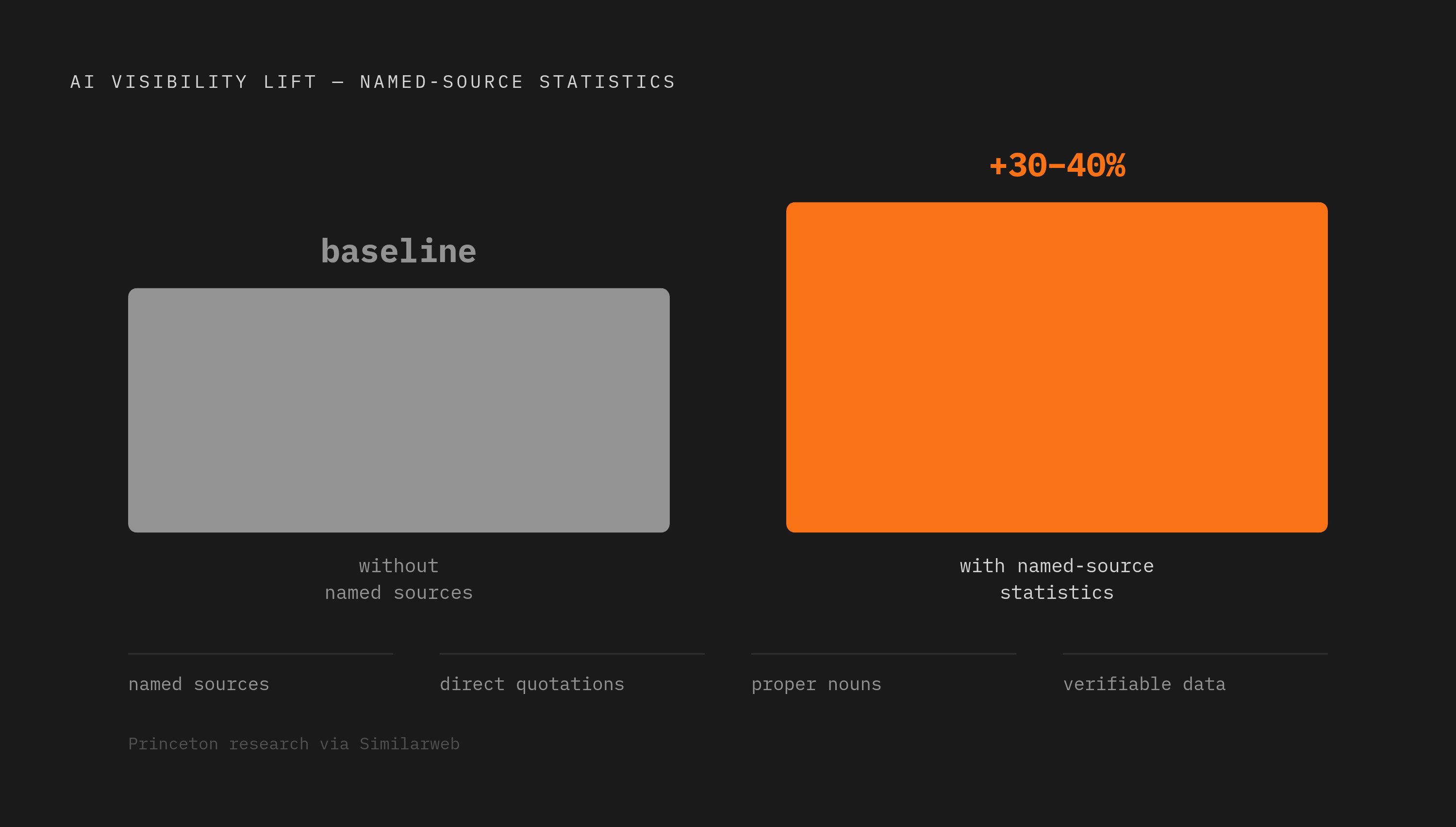
Named sources and direct quotations lift a page's AI visibility in measurable ways. Language models don't have a quirky fondness for quotation marks; attributing a claim to a named person or organization signals that the claim can actually be checked. Verifiable statistics carrying a named source perform even better, running 30 to 40 percent higher on AI visibility than content without that kind of grounding, according to Princeton research cited by Similarweb. It's the single most well-supported tactic that GEO research has produced so far.
Content packed with real names, real numbers, and real proper nouns gets cited noticeably more than content built from vague, general claims. Models seem to favor a concrete fact over an adjective every time, which tracks with how any skeptical reader would evaluate a claim too.
Original thinking counts for something distinct from all of that. Content built on first-person expertise and conclusions that aren't obvious shows that a person actually thought about the problem, evidence a summary stitched from five other existing articles can't produce. That's the same quality Google's 2026 information-gain weighting rewards on the traditional search side, one bar appearing in two measurement systems.
The trouble starts when teams treat "AI optimization" as a rewriting pass, one that strips out the specific, original perspective a piece had and swaps in generic, keyword-stuffed phrasing instead. That produces a page that looks optimized on paper and performs worse on both search and AI citation, which is the exact opposite of the intended outcome.
Human-authored content receives substantially more organic traffic than AI-only content, which pushes toward hybrid models: AI for scale, humans for the original perspective and editorial judgment that make content citable. Letterbrace's position on this is direct. AI-written content has to clear a real bar of usefulness and accuracy before it's worth publishing. Volume without those structural properties becomes a liability quietly wearing down the domain's authority every time it gets published.
