

A content team checks rankings, sees its page sitting in the top three for a term worth fighting for, and feels good about it. Then someone on that team actually runs the search, and watches Google answer the question itself, in a box above the fold, citing a competitor three ranks lower. That's the moment this whole article is built around. Ranking well and getting cited inside an AI Overview are two different outcomes now, and they take two different strategies to win. Google AI Overviews pull from multiple sources and hand the user an answer before that user ever scrolls down to organic listings, so a page can hold position one and still go unseen by the person who searched. Research published in 2026 found that the top organic result's click-through rate drops by more than half when an AI Overview appears, compared to searches without one, and that gap widened between an April 2025 measurement and a December 2025 one. The trend is not leveling off. A meaningful share of the URLs that AI Overviews cite rank outside the top 50 organically. A smaller site with a tightly structured, well-sourced page can get picked over a domain with ten times its authority. The reverse happens too: pages with strong domain authority and excellent rankings get passed over when Google can't easily lift an answer out of them.
How Google selects sources for AI Overviews
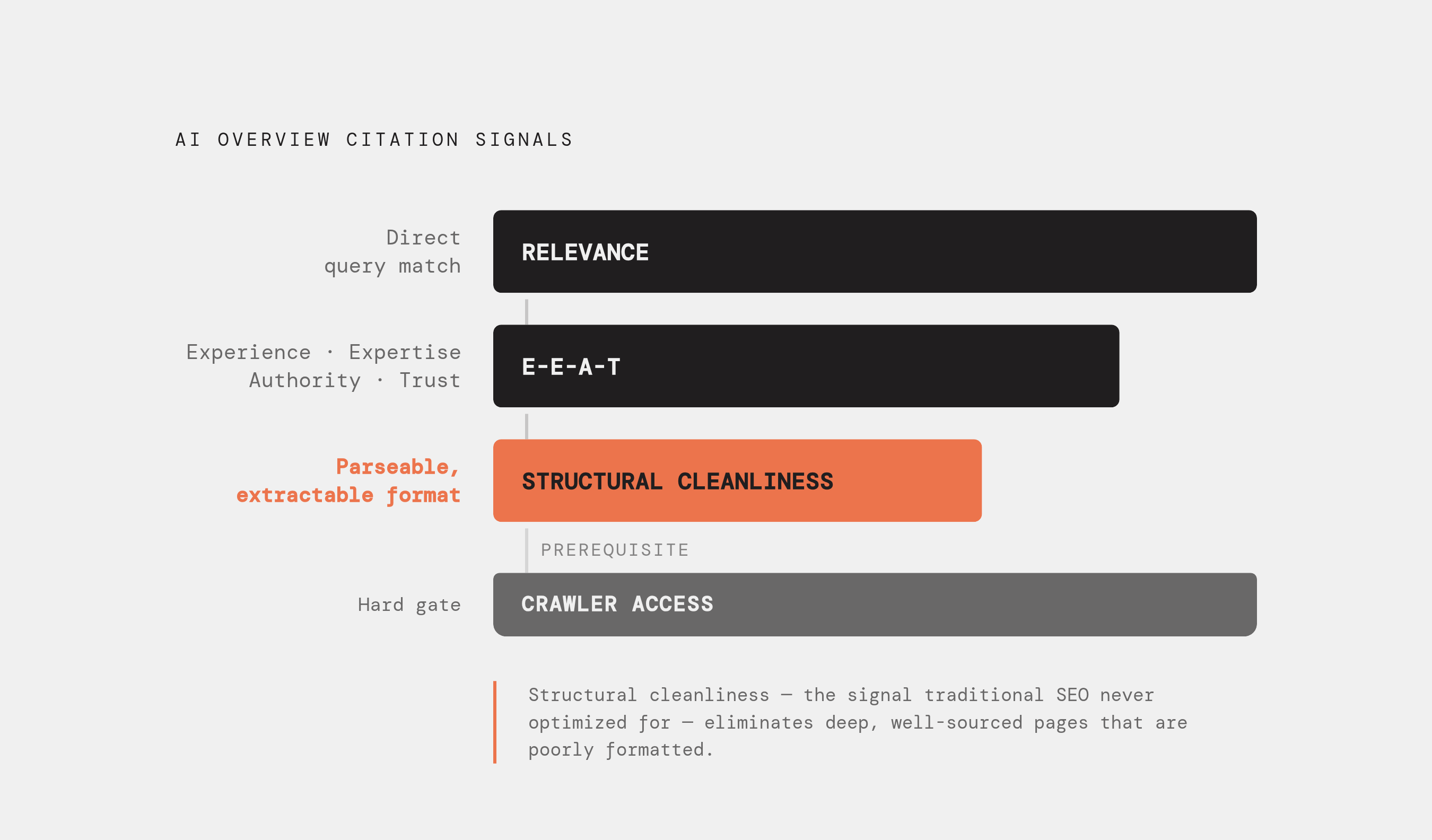
Picture Google's AI Overview system as a researcher working against the clock, not a librarian re-shelving books by relevance score. It runs on a retrieval-augmented generation process, which rewards two things traditional SEO never had to optimize for directly: extractability and authority, layered on top of relevance. When a query triggers an AI Overview, the system reads the intent behind the search, scans through indexed sources it already trusts, pulls out passages shaped like direct answers, and stitches them into a response. The writing in that response is original to Google. The sourcing behind it is not; it's citation-based, and the citations are visible to anyone who checks. Three signals decide which pages get pulled into that process: how directly a page answers the specific query (not just how broadly it covers the topic), how well it demonstrates the experience, expertise, authority, and trust markers Google calls E-E-A-T, and how cleanly it's structured. Content that's hard to parse gets passed over in favor of content that isn't, even when the hard-to-parse page covers the topic in more depth. The system doesn't simply lift from the featured snippet or crown the number-one result. It aggregates across sources, so a page built to nail one specific sub-question can earn a citation even while a bigger, more authoritative domain owns the broader topic and gets nothing. None of that matters if the page was never reachable to begin with. Sites that block AI crawlers get cited less, and that's a structural gate that sits in front of every editorial decision described in the rest of this piece. Fix the gate first. The tactics that follow assume the door is already open.
Writing content that AI systems can extract: the structure of a citable answer
Everything shifts once a writer stops composing for a person who scrolls and starts composing for a system that extracts. The two goals overlap more than they seem to at first. Readers want the answer fast, and so does Google's retrieval system, so writing for extraction mostly means writing with less throat-clearing. Picture a heading that asks "How long does employee onboarding usually take?" A version written for a scrolling reader might open with two sentences about how onboarding varies by company size and industry, then mention a few factors, then finally land on a number somewhere in paragraph three. A version written for extraction opens with the number: "Most companies complete employee onboarding in 90 days." Then it explains the variation, the factors, the exceptions. Same information, reordered so the answer comes first and the context comes after. That reordering is the whole craft. The direct answer belongs at the very start of each section, because burying it halfway down is one of the most common reasons strong, well-researched content still gets skipped. Supporting formats carry their own signal value: numbered steps tell the system "this is a process," comparison tables say "this is a multi-option decision," bullet lists flag enumerable points, and FAQ blocks mirror question-and-answer structure directly. Writing style matters as much as formatting. Content that circles a topic without landing on an answer, leans on vague or promotional language, or assumes the reader already knows the background, fails for the same reason: it gives the retrieval system nothing clean to grab. A short summary block at the top of a longer post raises citation odds, because the overview box often pulls from whatever it can extract cleanly first, and a tidy summary is usually the cleanest thing on the page.
Content types and formats that earn AI Overview citations most reliably
Not every content format is equally easy for an AI system to lift, and some structures read as authoritative and complete in a way that a quick opinion post never will. A framework article, one that names a structured approach step by step, gives Google something it can cite as a method. A comparison post, especially one built around clear "X versus Y" sections or a table, helps a reader weigh options against each other, and AI Overviews get asked that kind of question constantly. A page built around original industry data solves a different problem entirely: the system can't synthesize a statistic that only exists on one page, so proprietary numbers, survey results, and benchmarks become citations nobody else can replicate. A glossary works because each term-and-definition pair is independently extractable, so a single page can earn dozens of separate citation opportunities. Thorough how-to guides with clear numbered steps solve the process the same way a recipe solves dinner: step order matters, and Google can lift the step a searcher needs. FAQ-driven content works because its format already mirrors the question-and-answer shape AI systems are built around, so there's no translation needed between how the page is written and how the system wants to read it. Across all of these, long-form, well-structured, authoritative pieces consistently beat short opinion pieces at getting cited, even though brevity still matters inside each individual answer block. The lesson there isn't a contradiction: keep each answer tight, but build depth across the whole piece. And featured-snippet-optimized content correlates strongly with AI Overview citation, which makes winning a featured snippet a useful early signal that a page's extraction format is already working before an AI Overview ever touches it.
Building topical authority so Google treats a site as a trusted source, not a single page
Google's AI systems judge a site's depth of knowledge on a subject, not the quality of any single post sitting on it. A standalone page, however well written, earns the occasional citation and then goes quiet. A cluster of pages that cover a subject from multiple angles, link to each other with intent, and use the same vocabulary for the same ideas, earns citations consistently, because the system starts to recognize the site as a known quantity on that topic. There's a real distinction between covering a topic broadly and building a cluster deliberately. Covering a topic broadly means publishing a handful of posts that all touch the same general subject, which plenty of B2B SaaS content teams already do and consider sufficient. Building a cluster means something narrower and more disciplined: consistent terminology for the same named concepts and frameworks across every page, deliberate internal links that connect a pillar page to its supporting posts and back again, and entity consistency that helps Google's systems associate the brand itself with the ideas it keeps returning to. That underlying layer is called entity optimization, and it works because AI systems understand topics through entities: named concepts, frameworks, definitions. The payoff compounds into traditional organic rankings as well as AI search. A well-interlinked cluster strengthens traditional organic rankings and AI citation frequency at the same time, so the investment in building one doesn't have to be justified by AI visibility alone. It earns its keep twice.
Technical signals that determine whether Google can read and retrieve the content at all
The editorial craft above only matters once Google's systems can reach, parse, and trust the page. Crawler access sits at the bottom of the stack as a hard prerequisite: a site with indexing or crawling problems is working from a disadvantage before a single sentence gets evaluated, so keeping site architecture clean enough for bots to move through it easily is the first fix, not an optional one. That's usually a developer's job, not a writer's, so flagging it early keeps it from getting stuck behind a content calendar, and publishers who restrict crawler access to protect their traffic often speed up the very decline they're trying to stop, since a page that can't be read can't be cited, and a page that can't be cited gets skipped for the one sitting right behind it. Schema markup is the clearest structured signal a content team can hand Google about what a page actually contains and which questions it answers, and treating it as optional is a mistake most teams only discover once a competitor's FAQ block starts showing up in overviews instead of theirs. The recommended stack for a ranking page includes Article schema, FAQPage schema, and BreadcrumbList schema, all implemented in JSON-LD. Schema matters because it hands the retrieval system an explicit label for each block instead of making it guess: an FAQ section without FAQPage schema reads to the system as plain, unmarked prose, no different from a paragraph of opinion. That part is usually a developer task too, though a content strategist can flag which pages need it and in what order. Freshness acts as its own multiplier on top of all of that. Content that's been updated recently earns a noticeably higher citation rate than content left untouched, and a page last refreshed years ago competes poorly against a newer page answering the same query today. A workable cadence is to update evergreen content with new data, new examples, or added sections every three to six months, and to display the updated date somewhere visible, so both Google's systems and human readers can see the page hasn't been abandoned.
Off-site authority: how third-party citations and brand mentions affect AI Overview inclusion
Google's AI weighs whether other sources out in the world treat a brand as authoritative, not just whether that brand has published authoritative content on its own site. A business can do everything right on-page, structure every answer cleanly, keep its schema tidy, update its cluster every quarter, and still lose ground to a competitor that gets mentioned, reviewed, and cited across the web more often. Off-site presence functions as a citation signal in its own right, not a vanity number to report in a board deck. Brand mentions in industry publications, third-party references, reviews, and visible thought leadership all feed into how trustworthy a brand looks from the outside, and that outside view is what Google's systems are trying to approximate when they decide which sources deserve a citation. The practical implication for a content strategist is that earned media and brand visibility across other sites belong on the same planning sheet as the content calendar, not in a separate folder marked PR. A content team that treats off-site mentions as someone else's problem is leaving half the signal on the table.
