

For AI-automated content pipelines, it's about structural design: where and why approval is required before consequential decisions go out. Sounds bigger than it seems, and here's why: generative AI is on pace to reach $91.57 billion worldwide in 2026, expanding at close to 74% annually. This isn't a trickle. Picture a firehose: any team plugging AI inside their content workflow gets soaked.
The danger is velocity. Drafts can triple under an AI-automated pipeline, and without a structurally built-in brake, that pipeline will send triple the off-brand, flat-out false content live at the exact pace. No one picks that deal. It slips in unnoticed while everyone's caught up watching the drafts pile up.
Most teams assume this is already handled. To them, governance shows up as a style guide stashed in a shared folder, a review policy that nobody glances at twice, perhaps a Slack note begging someone to sanity check the AI output before it ships. All worth having, sure. None of it is in the pipeline. People miss it: once an agent uses AI for generating content and can publish, a policy document sits outside the loop. It's a sign taped up where nobody's looking.
Where those rules live is what separates a governed workflow from an ungoverned one. It's about where those rules live: built into the platform's architecture so they're never skipped, or buried in a document that rushed workers will ignore. Here, an update from MIT AI Risk Initiative's work found a clear pattern: governance frameworks center on model risk, and comparatively less on downstream issues in early-stage practices that shape what follows. This is a structural blind spot rather than a mindset issue, and it's exactly where the discussion is headed: mapping the checkpoint types a technically sound pipeline needs, plus the specific reason each must exist. It's a structural blind spot, and it's exactly the focus from here on: mapping the checkpoint types a technically sound pipeline needs, plus the specific reason for each.
What "human-in-the-loop" means when the loop is automated
"Human-in-the-loop" gets thrown around like it's self-explanatory. It's not self-explanatory. Done right, built-in thresholds in the pipeline automatically queue content so someone can review it before consequential work ships, rather than a vague claim that staff might intervene if they catch trouble.
A well-constructed loop performs a trio of specific functions. It sends what the system doubts to a reviewer. It tracks every choice the reviewer makes, so a trail stays visible. It feeds those choices to the pipeline, making the system sharper as it goes.
What it decidedly isn't: review once the article is live, the odd manual glance, or a policy calling for approval before you publish with zero technical enforcement. WordPress VIP's approach makes the distinction explicit. Without governance, review is just a rule that gets skipped anyway. In a governed setup, review gets built right into the architecture, making it impossible to skip.
The more AI takes on, the more this matters. Once a system stops drafting and starts actually doing things like publishing, restructuring a content program, unpublishing, or changing how a client is presented, skipping the loop gets expensive quickly. Here, the architecture has to earn its value. Rubrik's 2026 guidance says governance checks belong in the AI workflow itself, where validation, testing, and sign-offs are baked in before release. An automated system must never restructure strategy, unpublish content, or alter how a client is portrayed without someone approving it. It must be built in, not optional. This is a design requirement.
The five checkpoint types a governed pipeline requires, and the structural reason each one exists
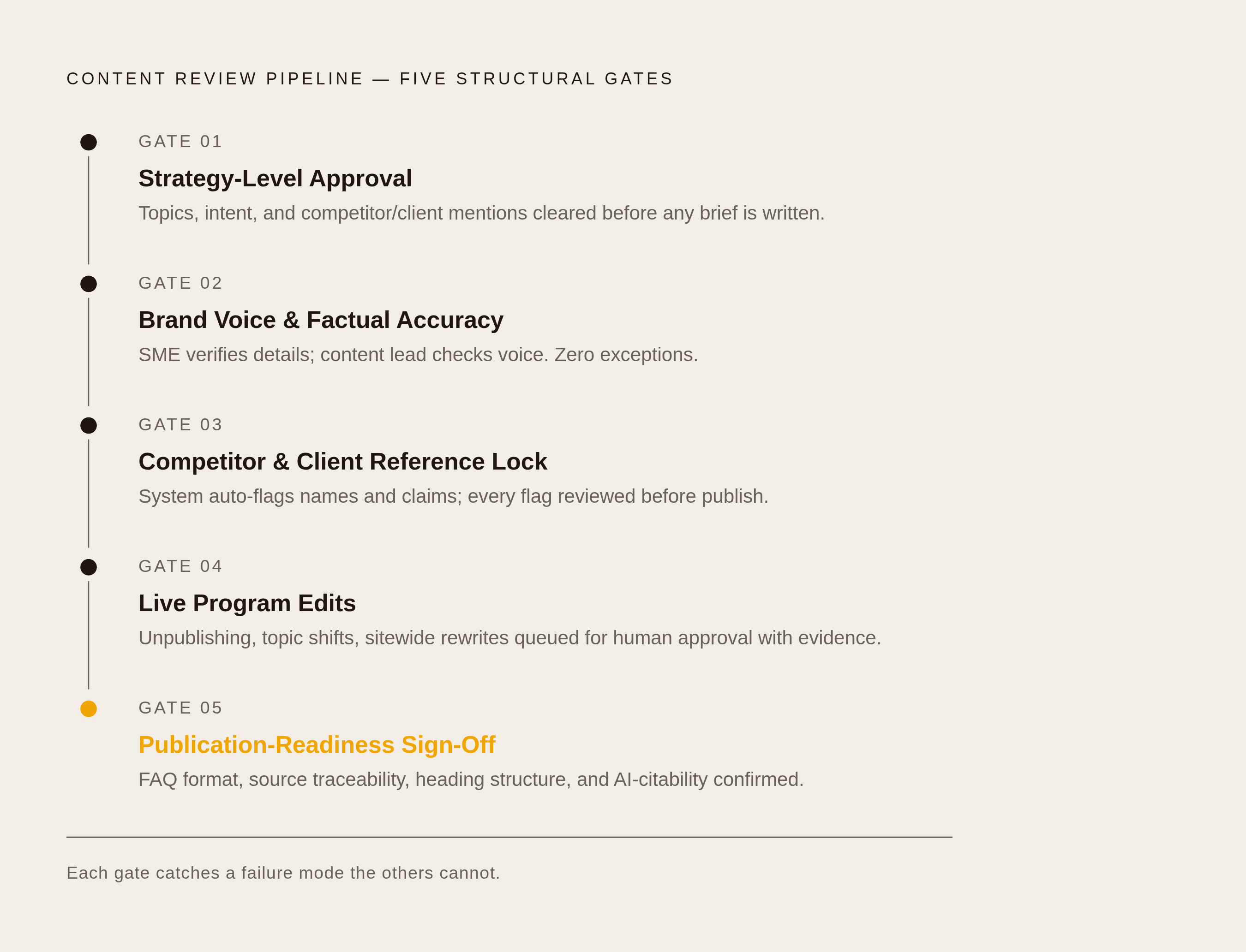
Checkpoints don't all behave the same way. Some hold an item back entirely until a person signs off. Some only flag an item and allow it through with a comment attached. Some run on every item moving through the pipeline, while some only trigger when a specific risk gets tripped. A governed pipeline actually needs 5 different checkpoints.
Checkpoint 1 sits first, with strategy-level approval required before even one content brief exists. Here, topics are picked, intent is set, and any competitor or client mention is cleared before the draft exists. The reason it belongs here first is simple: a brief gives instructions. Screw up the brief and that mistake spreads into every bit of content downstream, since fixing it after publication takes way more than catching it early. An AI system cannot make these calls alone: is a comparison deliberate and balanced, does a topic deserve coverage, does the angle fit the strategy the client is pursuing. Those decisions need a person, period.
Checkpoint 2 zeroes in on brand voice and factual accuracy across every draft. It exists because an AI is at zero each time without the persistent context the pipeline gives it, and when that layer is missing, facts get invented and voice drifts. Even with solid context, a person still has to review the output. This is no small thing. Among 800 enterprise decision-makers surveyed by WordPress VIP's, 85% said AI content posted without review hurts brand confidence. Smaller teams don't need a small army: Shadow Digital's two-gate model handles it, since Gate 1 requires a subject matter expert to verify details before anything goes live, plus a content lead checking voice and formatting, with zero exceptions. Gate 2 comes next, with the content lead reviewing pages live after 48 hours, catching what slipped through Gate 1. This checkpoint shows why treating brand voice like a technical specification matters: prompts pull voice from style guides, glossaries enforcing terminology and curated examples keep the AI anchored, leaving the reviewer confirming the spec stayed intact.
Checkpoint 3 locks down every competitor or client reference the pipeline produces before publication. Why the hard line? One inaccurate or careless rival mention goes beyond an oops: it's reputational risk and liability, and a policy document alone won't prevent it. Structurally, the system automatically flags competitor names and particular claim patterns, so every flagged mention needs someone to check it before publishing. Without this checkpoint, the AI goes to generic phrasing seen in every competitor's content, while the client's real edge quietly evaporates without being caught.
Checkpoint 4 governs every edit to a live program of content: unpublishing old pages, shifting the topic strategy, rewriting how a client appears sitewide, reassigning content toward different readers. Content already bringing in real search visits, or cited by an AI system, has value, and no model's private judgment should override that evidence unless someone actually checks the evidence and suggested shift. Gartner flagged this pattern in June 2025, noting more than 40% of agentic AI efforts will be scrapped by 2027 because spend spirals, returns stay murky, or risk checks were skipped from the start. That same hole sinks agentic AI work and sinks ungoverned content too. Structurally, each strategy move should land in a queue, where the system lays out the evidence on both sides, and someone can approve, edit, or block it before it actually executes.
The publication-readiness sign-off at Checkpoint 5 makes sure a piece is actually built for AI answer engines to cite, not just something that reads fine to people. WordPress VIP found 72% of enterprise leaders say freshness and publishing tempo still matter for discovery in AI-driven systems, but tempo without sound structure only yields content that is quick and unseen. This checkpoint checks for an FAQ-rich format, source traceability, a heading structure AI overviews can use, and improper gating of educational or comparison content. And before publish, it works as a real checklist a person uses, not an after-the-work audit when it's too far gone to matter. Windmill Growth's pre-publication checklist says to get evaluated on Evidence (are statements traceable?), Originality (does it offer a fresh take?), whether it answers the buyer's real problem, and Brand risk (would the accountable person defend that wording?).
The Role Map in a Real Content Operations Team
That doesn't take a swarm of fresh hires. A B2B SaaS content team needs governance ownership placed with the roles the team already has.
FUBYTE's 2026 role map breaks it down neatly. The brief, keyword intent, CTA, and Checkpoint 1 all sit with the strategist. The AI operator handles building the draft and its structure. The subject matter specialist reviewer checks nuance and correctness while co-holding Checkpoint 2. The role owner keeps the brand's tone and rule-following, sharing Checkpoints 2 and 3. RevOps does the UTM tagging and publish checklist, and controls Checkpoint 5. The strategy-reset approval at Checkpoint 4 sits with the team lead who owns content strategy, and this role should not pass into the AI system itself.
Frankly, it's absurd that 45% of B2B marketers intend to pour more money into AI-powered tools during 2026, funding the tools instead of workflow redesign. A faster ride won't do much when nobody's rebuilt the path. That role map functions as the road itself, turning the tools from something merely fast into something genuinely governable. Clarity Digital's 2026 framing names this shift strategist-as-architect: strategists quit drafting it all by hand and start directing AI tools toward specific tasks, where editorial oversight ends up the real work. Checkpoints keep that guidance from dissolving into empty promises.
smaller teams get value from the two-gate model since it's built around ownership rather than headcount. A single staffer handling compliance and brand voice can co-hold Checkpoints 2 plus 3. What can't be skipped is the gate being enforced by the system itself, not people remembering.
Prompt Libraries, Brand Core, and Governed Knowledge Bases as Pipeline Infrastructure
Statelessness drives voice drift, and sloppiness doesn't. Every session starts an AI model back at zero if the pipeline doesn't hand it something durable. Content built around a durable Brand Core learns the offering, positioning, competitors, and voice once, then applies it across every later asset without re-guessing each run.
A governed pipeline stays intact because of a few pieces of infrastructure. Brand Core, or a style specification: putting voice in prompts, using glossaries to lock terminology, and curated examples to ground tone, all as a technical spec, not someone's preference. When teams do this, their output is noticeably more reliable. Prompt libraries treated as versioned assets: keep proprietary prompts tracked for terminology and product-specific content, because without that, output gets inconsistent and knowledge gets stuck with one person. Governed knowledge bases: source-backed libraries the AI draws answers from, not ones it invents, and an AI retrieving from a governed source over synthesizing freely comes down to a call, not a limitation of the tech.
They all play the same role in the checkpoint system. A reviewer checks against them. At Checkpoint 2, the reviewer skips memory and compares the draft straight to the Brand Core. Infrastructure without checkpoints is like a vehicle with no brakes. Checkpoints without infrastructure are brakes missing a vehicle to slow down, with no way to actually enforce. Both halves need to exist. Ignore this and push out more, and the result is depressingly predictable: content plugging in AI with no real source, no voice guardrails, no review, reads well briefly before it quietly rots into filler riddled with factual drift.
How the Same Checkpoint Architecture Serves AI-Answer Visibility Alongside Search
Search now differs from AI-answer visibility, while the checkpoint structure above still serves both. LLM Pulse puts it like this for 2026: SEO gets a site ranking in search, AEO wins the answer spot in AI Overviews and snippets, GEO lands it a citation in a generative answer. A good strategy chases every one, though each asks the content to be structurally unique.
GEO asks for what SEO didn't bother with, like content structure, citation-friendly readability, source traceability for claims, and how data-rich it actually is. These aren’t extras tacked on later, but criteria for a checkpoint. Checkpoint 5 on publication-readiness is exactly the point where those rules go from aspirational to enforceable: heading structure, FAQ-rich format, keeping educational and comparison content off any gate.
A wrinkle shows up here as well. For WordPress VIP, 91% among enterprise leaders say it matters when content sounds more human; it's technical, not stylistic. AI answer engines train on human-written material, so when content reads like a machine produced it, citation odds drop even if every detail checks out.
Tracking ties everything together, and it has to capture more than just clicks and impressions. It needs to prove if AI systems actually take in content and cite it, while naming the client when real buyers ask, and any zero needs explaining, since bad tracking and a true authority gap seem identical unless someone digs deeper. A citation total missing a sample and confidence interval proves nothing; it's only a figure that sounds impressive in a deck. In a governed program, every AI-visibility assertion must be reported as successful outcomes relative to all asks, supported by statistical confidence. Letterbrace is built around this exact issue: shaping and tracking content to rank in search while getting AI-answer citation, with a person approving every structural move that matters before it goes live, positioned between an SEO firm that optimizes only for search plus a visibility tracker measuring all of it but publishing zero.
What governance looks like when it is working versus when it is theater
Good governance is boring, and that’s the point. Briefs need sign-off before anything gets generated. Drafts get measured against an actual Brand Core, not someone's hunch. Competitor mentions are flagged automatically, then reviewed each cycle, not only when a person remembers to check. Strategy shifts pause until someone weighs the evidence. And it only publishes after checking it's actually clear and citable to an AI system, not merely that it reads smoothly to someone scrolling.
Governance theater is hard to tell apart from afar, and that's what makes it risky. A style guide exists. A review policy is kept somewhere in a wiki. A Slack channel gets filled with "looks good" replies. It isn't wired into the system to actually stop a flawed draft from going live. The rules exist. They just aren't there when the call is made.
It's all in the architecture. It's architecture, showing up exactly when people rush, which isn't coincidentally when it matters most.
