

Prospective B2B customers now consult ChatGPT, Claude, and Perplexity to decide which tools deserve their trust, well ahead of ever launching a browser tab to run a search. The companies landing inside those answers are pulling in pipeline it couldn't capture otherwise, since today's shortlists take shape in spaces SEO never reaches.
Someone asks ChatGPT, "which CRM should I use for a startup?" The model answers directly, skipping the familiar list of ten blue links. Any brand missing from that response loses a buyer without ever getting a homepage visit. The whole selection happens within the chat itself.
That is not the same game as search rankings. A brand may nail every technical SEO requirement and earn plenty of trusted backlinks yet remain absent from an AI model's answer to a category question. The two systems are measured separately. In its 2025 category review, Zapier reported rapid growth in ChatGPT usage, with AI-generated answers appearing in nearly one out of every two searches, even on regular search engines.
The old marketing-team prompt, “where do we rank?”, now needs to be paired with a second: when a buyer asks, how does an AI model describe us against our competitors? Solving the ranking issue gives a company little insight into what AI says in comparison. Tracking, tools, and focus have to be built separately for that comparison, since a company’s own score only solves part of the problem.
Tracking Competitors in AI Answers
It is useful to know how often your brand appears in AI answers, but understanding the reason a rival gets mentioned instead is what truly shifts your next move.
When it comes to tracking your own visibility, the standard metric is called Share of Model, calculated by taking your brand's mentions and dividing that by the total queries you ran within that test group. The number you get is clean, showing you the frequency of your appearance. But it reveals nothing about the missed opportunities, those queries where you fail to appear while a competitor claims the position you sought.
Monitoring rivals pays off precisely in those blind spots. Whenever an AI response features a rival but omits you, prospective customers form shortlists that exclude your brand entirely, as the Sight AI resource detailing how to monitor model mentions explains thoroughly. Identifying such omissions is the simple step. The real challenge lies in uncovering how the model positioned that rival, including its exact assertion, the cited reference, and the assigned market segment. Being labeled "best for enterprise security" poses a distinct strategic threat compared to appearing as the "cheapest option for solo founders," despite identical weight in basic counts.
Reaching that depth requires a true prompt library rather than scattered, one-time searches. Sight AI's guide suggests tracking direct brand queries, questions framed around solving a problem, and requests that pit options against each other, plus running them across six or more major AI platforms. That breadth counts since a model's response to "what's a good project management tool" differs sharply from how it handles "Asana vs Monday for a 10-person team," so a rival might own one kind of prompt yet stay nearly invisible in the other.
The four dimensions of a competitor's AI presence worth measuring
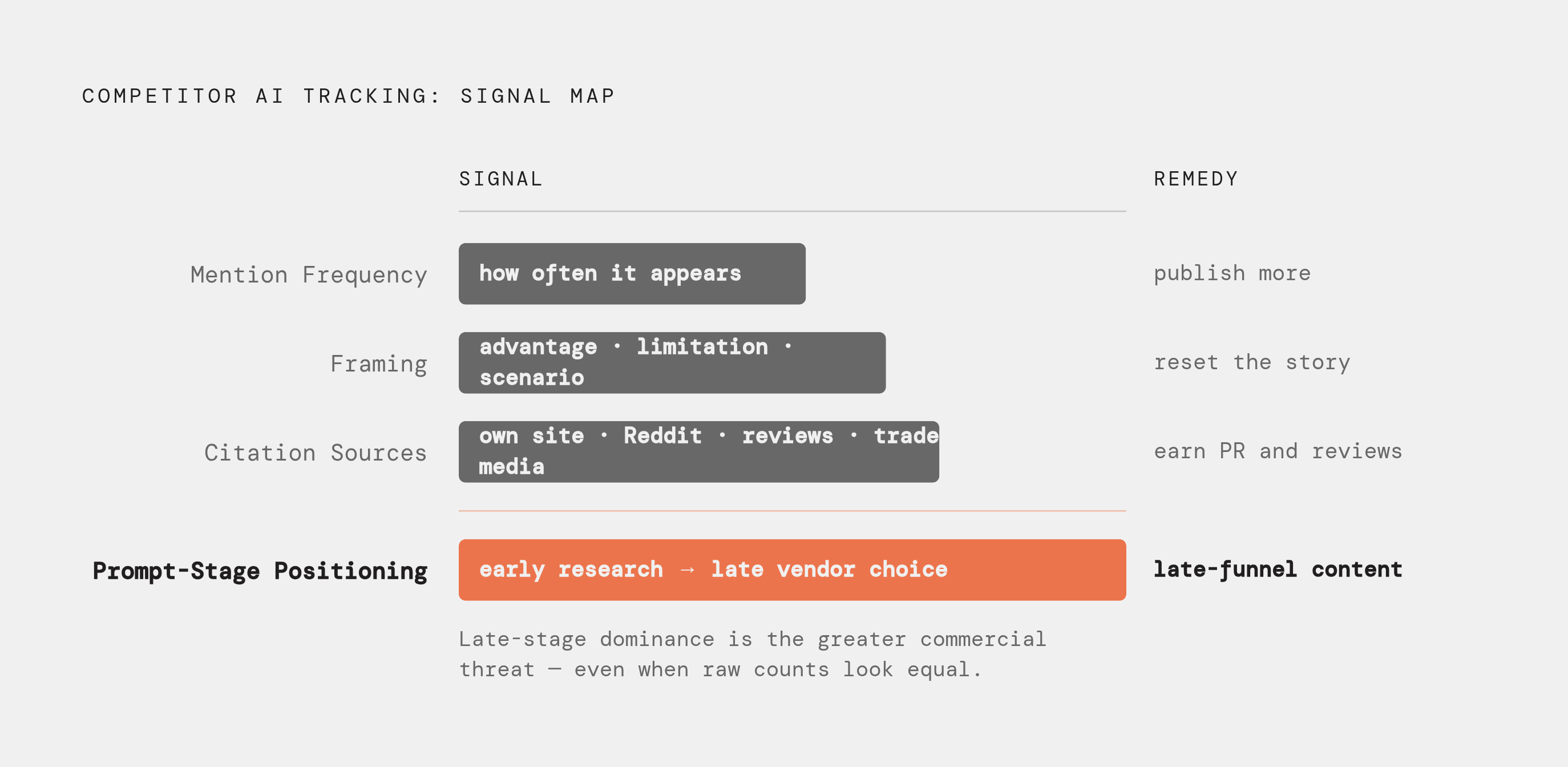
Strong competitor tracking separates four signals: mention frequency, framing, source material, and the buying-journey stage in which the competitor appears. Measuring just one of these leaves the picture incomplete and can sometimes be actively misleading.
Mention frequency comes first. It simply totals each competitor name in the prompts, signaling that the brand is visible enough to watch. It does not reveal whether the visibility is working in their favor or against them. On its own, the count offers little basis for action.
How well a reference is framed and its overall caliber close that gap. The analysis examines how an AI describes a rival, asking whether it highlights an advantage first, adds a limitation, ties the brand to a particular scenario, or groups it under a broader label. Botric's weekly Visibility Score blends tone at this stage with how often, where, and in what context a brand appears, because the way a reference sounds can alter its worth nearly as much as the reference does.
Citation sources address a separate issue: identifying the model's information origin. Zapier's assessment highlights how this capability stands out among features, revealing if a rival's success comes from their site, Reddit discussions, review compilations, or external blog content. That difference determines your response.
Prompt-stage positioning completes the view. A rival that repeatedly surfaces for late-stage buyer comparisons, including the “what is a CRM” vendor-choice questions, deserves far more attention than one limited to early research prompts. Both are a mention. But they pose very different risks.
The right response depends on which dimension is lagging. If the issue is frequency, the remedy is simply publishing more. If framing is the problem, the story needs to be reset, not just amplified. When sources are the weak spot, invest in PR and earning reviews in the places the model relies on. For a stage gap, create comparison material for late-funnel queries where the competitor leads.
Why AI models cite some competitors and not others
AI models choose what to surface using cues beyond product quality or business scale. They favor brands with a measurable blend of site architecture, outside credibility, and visibility on many platforms. It is not a black box.
Start with On-site structure. AI systems favor material capable of resolving a distinct query independently, requiring no surrounding page details for clarity. Structuring copy around inquiries, placing FAQs within pillar and product pages, and organizing text into standalone blocks lets a model extract and reference it easily. Models struggle to pull information out of lengthy blog posts where the key details appear deep within the text.
Content format carries equal weight. B2B SaaS sites most often see AI citations go to curated "best of" lists, head-to-head competitor comparisons, FAQs built into the page, original research pieces, and pages zeroing in on one particular pain point. Generic keyword-chasing articles that ignore real questions almost never earn citations.
External evidence of trust matters as well. Being referenced in third-party reviews, trade media, or lively community conversations matters more than content confined to the company’s own site. A rival cited on multiple reputable external sources has a built-in advantage over one that only talks about itself.
None of this is consistent from one platform to the next. ChatGPT, Claude, and Perplexity each rely on their own training data and retrieval setups, reaching distinct user audiences, so a competitor that shows up strongly in ChatGPT responses could be entirely absent from Claude or Perplexity, something Sight AI's guide highlights explicitly. That means checking source patterns one platform at a time, since they rarely transfer.
After seeing which references led a model to recommend a competitor, a company now knows which content and platforms deserve its attention. That is a concrete to-do list, not a vague push to “make more content.” And there’s no shortcut through it. Today, generative results on AI platforms cannot be bought as ad slots. To get cited, content has to be strong, easy for systems to retrieve, and supported by credibility elsewhere online. Paid media cannot force inclusion there.
The hallucination problem: when AI models say wrong things about competitors (and about you)
AI systems can make errors, yet buyers may hear those mistakes delivered with the same confidence as accurate answers. Any serious competitor tracking program must catch both cases, since being left out and being misrepresented point to different fixes.
The inaccurate statements identified to date span several areas: misrepresented product features, obsolete pricing structures or discontinued plans, unfounded assertions about security or regulatory adherence, fabricated alliances or credentials that lack any basis, and incorrect policies regarding refunds or cancellations. These are not uncommon scenarios invented to frighten marketing departments. They constitute a documented, inherent aspect of generative answer functionality.
This kind of skewing can work in either direction. One rival could be assigned a strength it lacks, steering the buyer toward that rival on false pretenses. Another rival could be burdened with stale criticism, such as a discontinued pricing structure, and you might prefer to set the record straight yourself, since buyers currently place heavy faith in AI responses and any falsehood circulating within a category erodes confidence in that entire space. That reasoning holds equally when the model turns to describing what you sell.
Because AI responses vary randomly instead of staying constant, testing a single query reveals little about the actual buyer experience. For that reason, Sight AI suggests executing every query two to three times on each platform in distinct sessions, since today's output might appear entirely unlike tomorrow's.
The log therefore cannot rely on a binary field for “did the competitor appear.” It has to preserve the model’s claim exactly as given, so teams can identify false or outdated statements, document them, and replace them later with accurate content. Letterbrace’s view on measurement fits this case directly: every zero should have an explanation with it. A spreadsheet can make a real absence look just like a failed tracking setup, yet those signals call for different interpretations, while invented claims must be distinguished from true ones before anyone chooses a response.
Building a competitor AI tracking program without drowning in prompt outputs
A workable program begins with a tight prompt set, tried across several platforms over many sessions and logged so it captures what was said, leaving aside any simple tally of mentions.
Begin by building out the prompt library. Sight AI lays out a prompt library anchored to brand-focused queries, problem-and-answer pairings, and head-to-head comparisons, worded just as a genuine shopper in every phase of their buying journey would actually search. A prompt library assembled from hunches about buyer language yields results that bear no resemblance to the way shoppers genuinely look for things.
Choose platforms with care. Sight AI's guide says to audit no fewer than six major platforms, including ChatGPT, Claude, Perplexity, Gemini and Copilot, plus other audience-relevant channels. Because each model uses different training data and reaches a different crowd, a competitor can fully own one platform and barely appear on another.
Run each prompt several times. Because the model can respond differently from one run to the next, a single trial shows only that run’s result instead of the wider experience buyers may encounter. Only repeated sessions can turn an isolated result into a pattern you can trust.
Track the right fields. Whenever a rival reference merits logging, capture what the model asserted precisely, the funnel-stage prompt responsible, its platform origin, plus any citation source URL the tool surfaces. Such granularity turns a buried document into actionable intelligence for the team.
Choose a testing rhythm, then keep it consistent. For high-priority brands, Sight AI's guide recommends testing each week; smaller operations can run checks biweekly, as long as the steps are documented so precisely that next quarter's run yields findings comparable with this quarter's. Keep the data in a single hub instead of separate platform spreadsheets, so you can quickly spot where a rival overperforms or lags and choose what to tackle first.
The Current Tooling Landscape
The tools developed for this category have grown up quickly, though most of them only watch and never act. That space between watching and acting matters, because knowing a rival is ahead doesn't solve the problem itself.
Amplitude's AI Visibility solution tracks how often brands appear across custom prompt libraries teams develop and refine, while its standout capability connects directly to the company's core analytics suite, mapping each AI response citation to concrete user actions like site visits, signups, and revenue. The package includes 500 tracked prompts free and monitors ChatGPT, Claude, Gemini, Google AI Overviews, and Perplexity.
Botric functions as an end-to-end GEO solution that monitors every prompt for brand references, then aggregates those signals to calculate a Visibility Score each week based on mention frequency, citation share, ranking placement, and sentiment. A built-in Content Agent identifies visibility gaps and generates publishable material, bridging the divide between diagnosis and resolution. Supported engines include ChatGPT, Perplexity, Gemini, Claude, plus both AI Overviews and AI Mode from Google.
It evaluates outputs from both ChatGPT and also Gemini.
Overall, these products are strong at tracking mentions, sentiment, citation sources, and platform breakdowns. The missing step is turning the alert that says "here's a gap" into "here's the specific, published content that fixes it" before the work has to be handed to a team midstream. Letterbrace fits into that handoff, using those monitoring gaps to create comparison content, FAQs placed on the page, and new research that make a citation more likely when a model next answers the question.
